MICRONUTRIENTS
Micronutrients are essential for plant growth and play an important role in balanced crop nutrition. They include boron (B), copper (Cu), iron (Fe), manganese (Mn), molybdenum (Mo), zinc (Zn), nickel (Ni) and chloride (Cl). They are as important to plant nutrition as primary and secondary macronutrients, though plants don’t require as much of them. A lack of any one of the micronutrients in the soil can limit growth, even when all other nutrients are present in adequate amounts.
Summary
- Due to higher yields, commodity prices and crop input costs, growers are reviewing all potential barriers to top grain production, including micronutrient deficiencies.
- In the major crops and production areas of North America, the micronutrients most often supplied by fertilization include zinc, manganese, boron and iron.
- Micronutrient deficiencies can be detected by visual symptoms on crops and by testing soils and plant tissues.
- The most reliable micronutrient soil tests are for zinc, boron, copper, and manganese. Though adequate, these tests are not as precise as those for soil pH, potassium and phosphorus.
- Plant tissue analysis is more reliable than soil testing for identifying many micronutrient problems, and can also supplement soil test information.
- Most often, micronutrients are soil-applied in a band at planting, or foliar-applied, as these methods allow lower use rates of sometimes expensive materials.
Micronutrients are essential elements that are used by plants in small quantities. For most micronutrients, crop uptake is less than one pound per acre. In spite of this low requirement, critical plant functions are limited if micronutrients are unavailable, resulting in plant abnormalities, reduced growth and lower yield. In such cases, expensive, high requirement crop inputs such as nitrogen and water may be wasted. Because of higher yields, higher commodity prices and higher costs of crop inputs, growers are reviewing all potential barriers to top grain production, including micronutrient deficiencies. This Crop Insights will discuss general micronutrient requirements, deficiency symptoms, soil and plant sampling, and fertilization practices. Future Crop Insights articles will discuss specific crops, their micronutrient or secondary nutrient requirements and management considerations.
Plant Requirements and Soil Availability
There are 16 elements essential to growth of crop plants:
Supplied by air and water: carbon, hydrogen, oxygen
Macronutrients: nitrogen, phosphorous, potassium
Secondary Nutrients: calcium, magnesium, sulfur
Micronutrients: boron (B), chlorine (Cl), copper (Cu), iron (Fe), manganese (Mn), molybdenum (Mo), and zinc (Zn). The 7 micronutrients are sufficient in most soils to meet crop needs. However, some sandy soils and other low-organic matter soils are naturally deficient in micronutrients, and high pH soils may make some micronutrients less available and therefore deficient. In the major crops and production areas of North America, the micronutrients most often supplied by fertilization include zinc, manganese, boron and iron. Basic chemical properties of micronutrients help determine their availability in soils.

Boron deficiency in alfalfa.
Chemical properties of micronutrients.
Table 1:
| Cations | |
|---|---|
| Copper | Positively charged- blind soil particles
Solublility is greatest under acid condition |
| Iron | |
| Manganese | |
| February | |
| Anions | |
| Borone | Negatively charged- Subject to leaching
In short supply in areas where they are |
| Clorine | |
| Molybdenum | |
| Zinc |
Because of complex chemical reactions within the soil, micronutrient availability is ultimately controlled by the equilibrium between the soil solution, soil organic matter, cation exchange sites, and insoluble compounds of micronutrients. Soil acidity or alkalinity has a large effect on the tie-up of micronutrients or their availability to plants. Micronutrients are most available in acid soils and often unavailable at high pH (Figure 1).
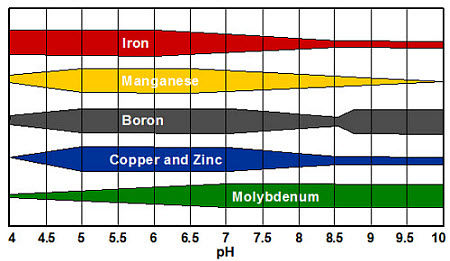
Figure 1. Relative availability of micronutrients by soil pH¹.
Organic Matter
Organic matter is a reservoir for essential plant nutrients, continuously supplying these nutrients to the crop as it decomposes over time. This reservoir is especially important for anions such as boron, which do not bind to soil particles and are therefore subject to losses. Soils that receive regular additions of organic residues such as manures rarely show micronutrient deficiencies. An exception is deficiencies caused by nutrient imbalances, such as a deficiency of manganese caused by an excess of phosphorus in overly manured soils. Another exception is soils of extremely high organic matter such as muck or peat soils. In these soils, strong, natural chelation (the combination of a micronutrient with an organic molecule) can make some micronutrients unavailable, particularly copper, manganese and zinc.
Micronutrient Removal by Crops
Crop yields are continually increasing due to genetic improvements in stress tolerance and disease resistance, incorporation of insect resistance traits, and use of seed treatments and other crop protection products. This means that more micronutrients are removed from the soil by each harvest.
By comparison, corn and soybeans remove about 50 to 100 lbs/acre of P and K in the grain, so it is apparent that micronutrient needs are only about 0.1% to 1% of macronutrient needs (except for iron, which is higher.)
Detecting Micronutrient Deficiencies
Micronutrient deficiencies can be detected by visual symptoms on crops and by testing soils and plant tissues. To understand visual symptoms, it is useful to know the role each micronutrient plays in plant growth and development.
Functions of Micronutrients
Micronutrients differ in the form they are absorbed by the plant, their functions and mobility in the plant, and their characteristic deficiency or toxicity symptoms. Iron or zinc deficiency symptoms in corn. Soil and tissue testing can help determine which of these nutrients is deficient.