BORON
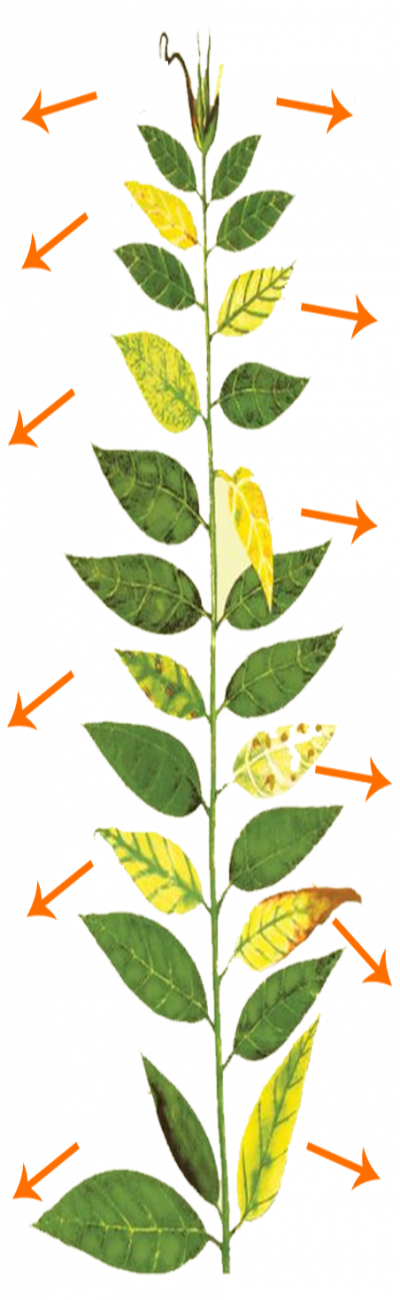
Discoloration of leaf buds,Breaking and dropping of buds.BORON
BORON : Discoloration of leaf buds,Breaking and dropping of buds.
SULPHUR
Leaves light green,veins pale green,No SpotsSULPHUR
SULPHUR : Leaves light green,veins pale green,No Spots
MANGANESE
Leaves pale in color,Veins and venules dark green & reticulated.MANGANESE
MANGANESE : Leaves pale in color,Veins and venules dark green & reticulated.
ZINC
Leaves pale,narrow and short veins dark green, Dark Spots on leaves and adges.ZINC
ZINC: Leaves pale,narrow and short veins dark green, Dark Spots on leaves and adges.
MAGNESIUM
Paleness from leaf edges .No spots, Edges have cup shape fold.MAGNESIUM
MAGNESIUM : Paleness from leaf edges .No spots, Edges have cup shape fold.
PHOSPHORUS
Plant short and dark green In extreme deficiency turn brown and black.Bronze color under the leaf.PHOSPHORUS
CALCIUM
Plant dark green.tender leaves pale.Drying starts from the tips,Eventually leaf bunds die.CALCIUM
CALCIUM : Plant dark green.tender leaves pale.Drying starts from the tips,Eventually leaf bunds die.
IRON
Leaves Pate , No spots,Major Veains Green.IRON
IRON : Leaves Pate , No spots,Major Veains Green.
COPPER
Pale pink,between the veins white & dots.COPPER
COPPER : Pale pink,between the veins white & dots.
MOLYBDENUM
Leaves light green/lemon yellow/orange.Spots on whole leaf except veins,Sticky secerations under the leaf.MOLYBDENUM
MOLYBDENUM : Leaves light green/lemon yellow/orange.Spots on whole leaf except veins,Sticky secerations under the leaf.
POTASSIUM
Small spots on the tips, edges of pale leaves, spots turn rusty,Fold at tipsPOTASSIUM
POTASSIUM : Small spots on the tips, edges of pale leaves, spots turn rusty,Fold at tips
NITROGEN
Stunned growth.Extremely pale color,Appear burnt in extreme deficiency.NITROGEN
What is Micronutrients:
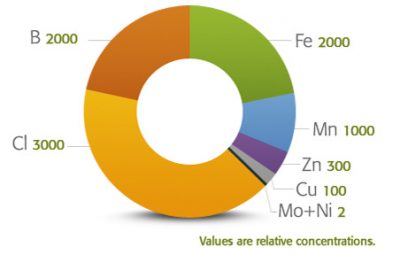
Micronutrients are essential for plant growth and play an important role in balanced crop nutrition. They include boron (B), copper (Cu), iron (Fe), manganese (Mn), molybdenum (Mo), zinc (Zn), nickel (Ni) and chloride (Cl). They are as important to plant nutrition as primary and secondary macronutrients, though plants don’t require as much of them. A lack of any one of the micronutrients in the soil can limit growth, even when all other nutrients are present in adequate amounts.
Nutrient Deficiency Symptoms of Plants
Growing plants act as integrator of all growth factors and are the products in which the grower is interested. Therefore, careful inspection of the growing plant can help identify a specific nutrient stress. if a plant is lacking in a particular nutrient, characteristic symptoms may appear. Deficiency of a nutrient does not directly produce symptoms. Rather, the normal plant processes are thrown out of balance, with an accumulation of certain intermediate organic compounds and a shortage of others. This leads to the abnormal conditions recognized as symptoms. Visual evaluation of nutrient stress should be used only as a supplement to other diagnostic techniques (i.e., soil and plant analysis). Nutrient deficiency symptoms may be classified as follows:
-
Complete crop failure at the seedling stage.
-
Severe stunting of plants.
-
Specific leaf symptoms appearing at varying times during the season.
-
Internal abnormalities such as clogged conductive tissues.
-
Delayed or abnormal maturity.
-
Obvious yield differences, with or without leaf symptoms.
-
Poor quality of crops, including differences in protein, oil, or starch content, and storage quality.
-
Yield differences detected only by careful experimental work.
- The visual symptom may be caused by more than one nutrient. For example, N-deficiency symptoms may be identified, although S may also be deficient and its symptoms may not be readily apparent. B deficiency is accompanied by a red coloration of the leaves near the growing point when the plant is well supplied with K. on the other hand, when the K content is low, yellowing of alfalfa leaves occurs.
- Deficiencies are actually relative, and a deficiency of one nutrient may be related to an excessive quantity of another. For example, Mn deficiency may be induced by adding large quantities of Fe, provided that soil Mn is marginally deficient. Also, at a low level of P supply, the plant may not require as much N compared to normal or adequate P. In other words, once the first limiting factor is eliminated, the second limiting factor will appear (Liebig’s law of the minimum)
- It is often difficult to distinguish among the deficiency symptoms in the field, as disease or insect damage can resemble certain micronutrients deficiencies. For example, leaf hopper damage can be confused with deficiency in alfalfa.
- A visual symptom may be caused by more than one factor. For example, sugars in corn combine with flavones to form anthocyanins (purple, red, and yellow pigments) and their accumulation may be caused by an insufficient supply of P, low soil temperature, insect damage to the roots, or N deficiency.