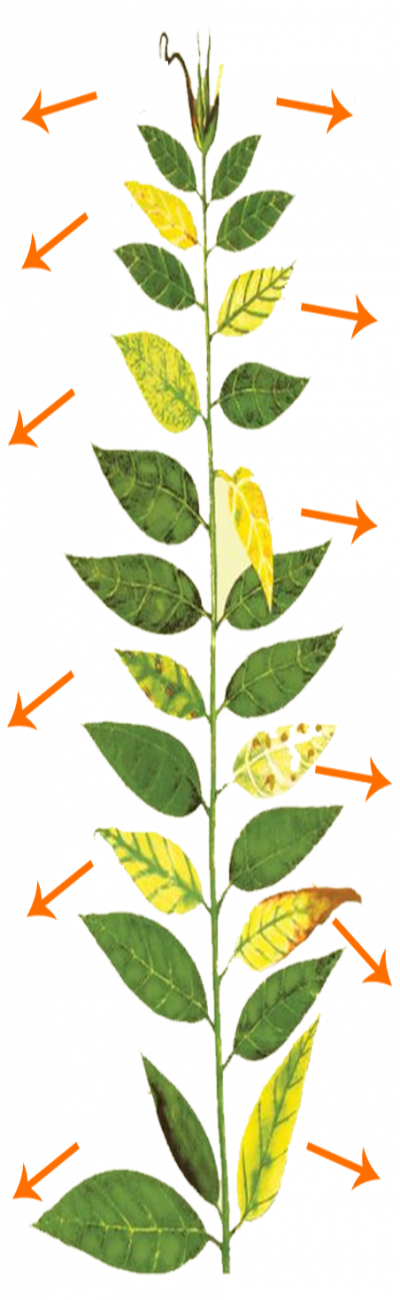
Boron (B)
Boron is included in the Standard Soil Test. The level of soil boron is “insufficient” or “low” when ex tractable boron is less than 0.1 pound per acre. Soil boron is found in both organic and inorganic forms that are made available to plants as either or both soil organic matter is decomposed and/or boron-containing minerals dissolve. There may be between 20 to 200 pounds boron in the surface layer of South Carolina soils, but only a small portion is available to plants. Boron, as the borate (BO3 3-) anion, is mobile in the soil and can be easily leached from the surface soil.
Calcium, potassium, and nitrogen concentrations in both the soil and plant can affect boron availability and plant function, the calcium:boron (Ca:B) ratio relationship being the mostimportant. Therefore, soils high in calcium will require more boron than soils low in calcium.The chance for boron toxicity is greater on low calcium-content soils.
The need to include boron in the fertilizer recommendation is determined by:
• crop requirement
• soil boron test level
For any given crop when boron is recommended, a high rate of boron may be required on:
• clay-type soils
• soils that are high in water pH and/or calcium content
• high organic matter content soils
• Where soils boron is broadcast versus boron being either banded or foliar applied
Boron is routinely included in the fertilizer recommendation for the crops cotton, peanut, alfalfa,apple, root crops, cabbage, broccoli, and cauliflower, and when reseeding clover or where clover seeds are to be harvested.
When applied as a part of a soil fertility program, many types of animal manures, superphosphate (0-20-0), and liming materials may contain sufficient boron to meet the boron requirement for some crops. Crops differ in their sensitivity or tolerance to boron, crops most sensitive being peach, strawberry and soybean; corn, tobacco, tomato and small grains being moderately tolerant to boron; while the crops, cotton, sunflower and alfalfa are the most tolerant. When boron deficiency symptoms occur, boron is recommended at application rates determined by crop as given below:
Application Rates of Boron Recommended for Correcting Boron Deficiency by Crop
| Crop | Amount Applied | Crop | Amount Applied |
|---|---|---|---|
| Alfalfa | 2.0 – 4.0 | Grapes | 0.6 – 1.0 |
| Apple | 0.3 – 1.4 | Peanut | 0.3 – 0.5 |
| Cabbage | 1.0 – 4.5 | Pea | 0.9 – 1.2 |
| Carrot | 1.0 – 1.7 | Potato | 0.6 – 1.0 |
| Clovers | 0.6 – 2.3 | Strawberry | 0.6 – 1.0 |
| Corn | 0.6 – 1.0 | Sweet Potato | 0.6 – 1.7 |
| Cotton | 0.6 – 1.0 | Tomato | 0.6 – 1.7 |
Care is needed not to exceed both recommended boron soil and foliar application rates since boron toxicity is a definite possibility. A plant analysis is the best method for determining when boron is actually needed. Soil test boron is “excessive” when extractable boron is greater than 3.0 pounds per acre.
Boron exists in the soil solution as the borate (BO33-) anion
List of Boron-containing Commercial Fertilizers
| Source | Formula | % B Content |
|---|---|---|
| Borax | Na2B4O7.10H2O | 11 |
| Boric Acid | H3BO3 | 16 |
| Solubor | Na2B4O7.4H2O + Na2B10O16.10H2O | 20 |